
Artificial Intelligence
What Is an AI Money Coach? The Five Types, What They Cost, and What They Can't Do
Vera Editorial
·

Ask ten fintech companies what an "AI money coach" is and you'll get ten answers, because ten different products are wearing the same jacket. One is sorting your Starbucks charges into a "Coffee" bucket. Another is a licensed human being with a chat interface bolted on. Both are advertised with the same three words.
An AI money coach is software that uses machine learning to help you manage everyday money — categorising spending, answering questions in plain language, forecasting cash flow, and nudging behaviour. It is not a financial advisor. Most of these products are not registered with any financial regulator, and their own terms of service say, in writing, that nothing they tell you is advice. A handful are backed by a registered investment adviser, and even there the registration usually does not extend to the chatbot.
This guide sorts the category into five types, prices twelve plans against each other with figures verified from each company's own pages in September 2026, and shows what the newest research actually found — including the part most coverage got backwards.
Quick answers:
Is it a financial advisor? No. A fiduciary duty attaches to a specific advisory relationship, most commonly with a registered investment adviser. Three companies in the table below operate one — but in two of the three, that duty does not cover the AI you'd actually be talking to.
Does it cost money? Anywhere from $0 to $479.88 a year. Price predicts remarkably little.
Does it work? The best 2026 evidence — on general-purpose AI models, not on these apps — found the advice reasonable on average, and noticeably better for people who already know how to ask.
The five things "AI money coach" actually means

They stack. A tier-3 product almost always does tiers 1 and 2 as well. What matters is the deepest tier a product genuinely reaches, because that's what you're actually paying for.
1. Categorisation that learns
The oldest and most boring layer, and the one that works best. The app reads your linked transactions and sorts them into buckets, getting better as you correct it. Copilot Money calls its version Copilot Intelligence and describes it plainly: it "uses Machine Learning to better predict your transactions' categories based on the transactions you've reviewed in the past."
Where it stops: description. It can tell you that you spent $340 on food delivery last month. It has no opinion about whether that was a good idea. If you want the buckets to actually change behaviour, that's a budgeting method problem, not a categorisation problem.
2. A chatbot you can talk to
This is what most people mean by "AI money coach" now — a chat window with your balances in context, so you can ask "can I afford this?" and get a sentence back instead of a spreadsheet. It's genuinely useful for the questions you'd otherwise never bother to work out.
Where it stops: generation. It can be fluent and wrong in the same breath, and the companies know it. Albert's Genius User Guidelines put it verbatim: "The responses generated by Albert Genius should not be construed as financial, legal or tax advice." Its separate Genius overview page adds: "Genius uses generative AI which can make mistakes." That's not a legal formality buried in a PDF — it's on Albert's own help centre, and it's an accurate description of the technology.
If you want to know how a purpose-built money AI differs from typing the same question into a general chatbot, we've written that up separately: how Vera's AI differs from ChatGPT, and a set of prompts that get better answers out of either.
3. Forecasting and cash-flow prediction
Projects your balance forward from recurring income and bills, and — the useful bit — flags the date you go negative before you get there. This is the tier that actually prevents overdrafts, because it converts a vague worry into a date.
Where it stops: your history. Forecasting works by assuming next month looks like the last six. Irregular income, a surprise vet bill, a landlord raising rent — the exact events you most need warning about are the ones it models worst. If your income is lumpy, treat every forecast as a starting point rather than a number.
4. Human experts, bundled with software
Here the app is the front door and a licensed human is the product. Origin bundles financial planning at $99 a year. Empower gives away the dashboard and makes its money once you cross an investable-asset threshold.
Where it stops: price and access. This is the only tier where a fiduciary duty can attach to the answer you get — and the reason is the human, not the AI.
5. Agentic AI that acts on your behalf
Moves money without asking each time: sweeping to savings, paying down a card, cancelling a subscription. Copilot's Money Assistant moved this direction in 2026, and could "create, update, and delete categories, budgets, transactions, recurring transactions, and rules" by its August 2026 update — though Copilot still labels it a beta.
Where it stops: reversibility. Consumer agentic finance is still narrow and mostly opt-in, and for good reason. A wrong answer at tier 2 costs you trust. A wrong action at tier 5 costs you money.
What a year actually costs — and who's accountable

Plan | Cost per year | Billing | SEC-registered investment adviser? |
|---|---|---|---|
Empower Personal Dashboard | $0 | Free | Yes — Empower Advisory Group, CRD 112058. Advisory relationship starts at $100K investable assets |
Vera | $0 | Free | No |
Quicken Simplifi | $47.88 | Annual, promo rate ($3.99/mo; list $6.99/mo) | No |
Cleo Plus | $71.88 | $5.99/mo × 12 — no annual plan | No |
Copilot Money | $95.00 | Annual ($13/mo monthly) | No |
Origin | $99.00 | Annual — currently $1 for year one | Yes — Origin Investment Advisory LLC, CRD 305353 |
Monarch Core | $99.99 | Annual ($14.99/mo monthly) | No |
YNAB | $109.00 | Annual ($14.99/mo monthly) | No |
Rocket Money Premium+ | $180.00 | $15/mo × 12 — includes the Rowan AI assistant | No |
Monarch Plus | $199.00 | Annual (promo pricing shown on site) | No |
Albert Standard | $239.88 | $19.99/mo × 12 — no annual plan | Yes — Albert Investments, LLC, CRD 298006 |
Albert Genius | $479.88 | $39.99/mo × 12 — no annual plan | Yes — same entity; AI guidance expressly disclaimed |
List prices verified 9 September 2026 from each company's own pricing page, help centre or App Store listing. Rocket Money's cheaper Premium tier is pay-what-you-choose ($7–$14/month) and has no comparable annual figure, so its fixed-price Premium+ tier — the one carrying the Rowan AI assistant — is shown instead. Registration checked against the SEC's Investment Adviser Public Disclosure database.
Three things worth pulling out of that table
The paid range is 10× and it tells you almost nothing. The most expensive plan on the chart costs $479.88 a year. The plan with an actual financial planner attached costs $99. Whatever you're paying for at the top of the range, it isn't accountability.
Albert's price went up and the internet hasn't noticed. The $14.99 Genius tier that appears in roughly every "best AI money app" listicle no longer exists. Albert's current tiers are $19.99, $39.99 and $39.99 a month, with no free tier. Albert's own help centre lists the current tiers; its App Store description still quotes $14.99 for Genius — it's stale, and it's why so many comparison articles are wrong. Trust the help centre over the store listing.
Two apps publish no annual plan at all. Albert and Cleo bill monthly, full stop. Their figures above are monthly × 12, which is what you'll actually pay. That's a meaningful markup against a $95 Copilot or a $99 Origin, and it's easy to miss when you're comparing a $5.99 line item against a $99 one.
For head-to-head detail on specific matchups, we keep separate breakdowns: Vera vs Cleo, Vera vs Monarch Money, Vera vs Rocket Money and Vera vs Mint. A wider sweep of the category lives in the best AI money tools in 2026.
Coaching versus advice: the distinction nobody explains
This is the part that actually matters, and almost no article covers it, so here it is plainly.
"Financial advice" is a regulated activity in the United States. If a firm gives advice about securities for compensation, it generally has to register as an investment adviser with the SEC or a state regulator, and a registered adviser owes its clients a fiduciary duty — a legal obligation to act in your interest, not its own.
"Coaching" is not regulated at all. Anyone can call themselves a money coach. Any app can call itself one. There's no licence, no exam, no filing, and no duty of care.
That's why the disclaimers in these apps are so uniform. Cleo's terms state, in capitals: "CLEO DOES NOT INTEND TO PROVIDE YOU WITH ANY LEGAL, TAX, OR FINANCIAL ADVICE THROUGH THE APPLICATIONS, SITE, OR SERVICES. CLEO IS NOT A LAWYER, TAX ADVISOR, BROKER, OR FINANCIAL PLANNER." Rocket Money's terms carry a heading that reads "Not a Financial Planner, Broker or Tax Advisor." Quicken's Simplifi terms: "We never give legal, financial, accounting, tax, investment, healthcare, real estate, or other professional services or advice." YNAB: "Information presented through YNAB does not constitute financial, accounting, tax, or investment advice." Monarch and Copilot say materially the same thing.
None of that is a scandal. It's accurate. These are budgeting tools, and budgeting tools are useful. The problem is only that the marketing says "coach" while the terms say "not advice," and most people never read the second one.
The registration carve-out
Here's the twist that makes registration less useful than it sounds. Albert, Empower, Origin and Stash all operate SEC-registered investment advisers. But registration attaches to a specific advisory relationship, not to the whole app — and at Albert, the AI chat most users think of as the coach is explicitly carved out of it. Albert's own words again, from its Genius overview page: "Albert Genius is not a licensed financial advisor," and "Genius does not provide investment recommendations."
So the honest version is this: registration tells you a regulated entity exists somewhere in the building. It does not tell you that the thing answering your question at 11pm is covered by it.
The regulatory gap isn't closing quickly, either. The SEC proposed a rule in 2023 on conflicts of interest in firms' use of predictive data analytics — the closest thing to AI-specific investor protection on the table — and withdrew it in June 2025, alongside thirteen other proposals. Nothing has replaced it. The SEC said only that any future action would come via a new proposed rule.
If your actual question is about investing rather than budgeting, we go deeper on where the line falls in can AI help with investment decisions.
What the 2026 research actually found
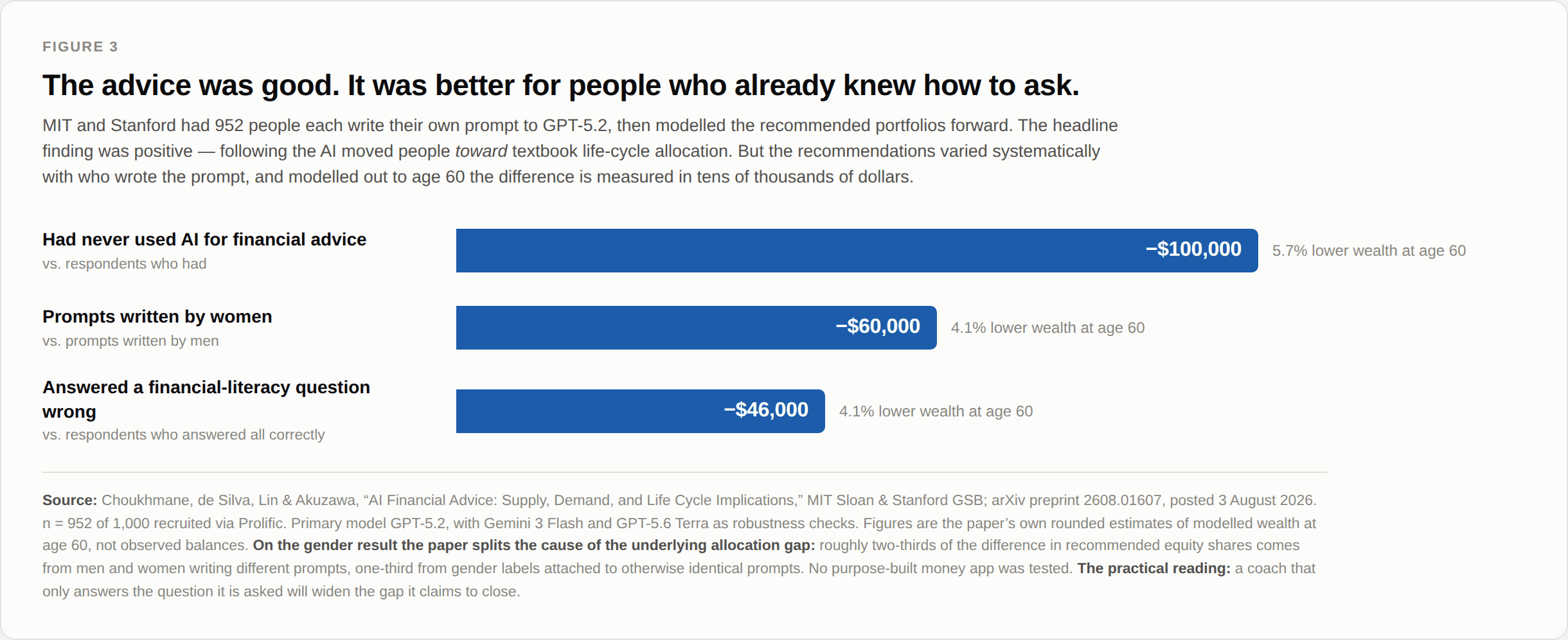
In August 2026, researchers at MIT Sloan and Stanford GSB — Taha Choukhmane, Tim de Silva, Weidong Lin and Matthew Akuzawa — published the most detailed study to date of what happens when ordinary people ask an AI for financial advice. They recruited 1,000 US adults, analysed 952 of them, had each write their own prompt to GPT-5.2, and modelled the recommended portfolios forward to age 60. Robustness checks used Gemini 3 Flash and GPT-5.6 Terra.
One caveat to hold onto before the numbers: the study tested general-purpose AI models. No purpose-built money app was in it — including ours. What follows is evidence about the technology underneath these products, not a test of the products themselves.
Start with the headline finding, because most coverage buried it: the advice was good. Following the AI's recommendations moved respondents toward standard life-cycle theory — the textbook answer about how your asset allocation should shift as you age. On average, people ended up better allocated than they started. If you were expecting a hit piece, that isn't what the paper says.
Then the uncomfortable part. The recommendations varied systematically with who wrote the prompt:
Respondents who had never used AI for financial advice before got recommendations that modelled out to about $100,000 less — 5.7% lower wealth at age 60.
Prompts written by women produced recommendations worth about $60,000 less than prompts written by men — 4.1% lower.
Respondents who got even one financial-literacy question wrong got recommendations worth about $46,000 less — 4.1% lower.
The gender result is the one worth understanding precisely, because the paper decomposes the underlying allocation gap: roughly two-thirds of the difference in recommended equity shares comes from men and women writing different prompts (the demand side), and roughly one-third from gender labels attached to otherwise identical prompts (the supply side). Both halves are real. Only one of them is something you can do anything about.
What that means in practice: the characteristics of the person asking are worth tens of thousands of dollars — partly because they shape the prompt, and partly because the model answers differently depending on who it thinks is asking. The first half you can fix by asking better. The second half you can't, which is exactly why the burden belongs on the product to ask the follow-up question rather than on you to know it exists.
What most people actually think about this
Gallup, surveying 5,075 US adults aged 21+ in spring 2026 in partnership with Edward Jones, found that among Americans who have sought financial guidance from any source, 18% have sought it from AI tools — ChatGPT, Claude and similar. Read the denominator carefully: that's a share of guidance-seekers, not of the population, and AI still ranks below plain internet research (73%), family (35%) and professional advisors (32%).
That's also usage, not endorsement, and the confidence numbers are much lower: "No more than three in 10 adults in either country have at least some confidence in AI as a source of financial guidance, and very few have a great deal of confidence: 3% in the U.S. and 4% in Canada."
The generational split is stark. Among guidance-seekers, AI use runs 26% for Gen Z and 25% for Millennials, against 16% for Gen X and 7% for Baby Boomers. Confidence follows the same shape — 36% of Millennials and 32% of Gen Z report at least some confidence.
Which is roughly the right posture, honestly: a lot of people are using these tools while trusting them only partly. That's not naivety. That's how you should use them. We dug into what this generational gap means for long-run outcomes in Gen Z and the retirement future and Gen Z wealth building with AI.
Products that "best AI money coach" lists still recommend — and shouldn't
Listicles rot. Here's what's actually true as of September 2026.
Cleo — still running, but check the FTC file first. In March 2025 the FTC announced that Cleo AI had agreed to pay $17 million to settle allegations it deceived consumers about its cash advances. The FTC's own summary: "Cleo AI has agreed to pay $17 million to settle the Federal Trade Commission's allegations that the company deceived consumers about how much money they could get and how fast that money could be available." The allegations covered advertised advance amounts almost nobody received, "instant" transfers that required an extra fee, and difficulty cancelling. Cleo agreed to settle in March 2025; the FTC still lists the case as pending on its docket. Cleo is a real product with real users — just go in informed. (Our side-by-side: Vera vs Cleo.)
Mint — gone since March 2024. Intuit wound it down and pushed users to Credit Karma. It still appears in listicles published this year. If a comparison article recommends Mint, stop reading it. (Vera vs Mint covers what to move to.)
Charlie — and be careful which Charlie. The debt-payoff app with the penguin (hicharlie.com) wound down after Chime announced in August 2021 that the team was joining — Chime's post said only that "the Charlie app is going away." There's a separate, unrelated company also called Charlie, a banking service for people 62 and over, founded in 2023 — it is not the same product, and claims circulating about its closure don't trace to any announcement we could find.
Zeta — acquired by Acorns. The couples-and-families finance app was acquired by Acorns in an asset deal announced June 24, 2025; terms weren't disclosed, and Acorns invited existing Zeta customers to move over. No shutdown date has been announced. If you're specifically looking for shared-finance tooling, we compare the current options in best budgeting apps for couples.
Douugh — read this one carefully, because it's usually reported wrong. The listed company renamed itself Stakk Limited and changed its ASX ticker from DOU to SKK in early 2025, and the shares are currently flagged as halted or suspended. But the consumer app is not dead — douugh.com is live and marketing a cash-advance product repayable over 4, 12 or 24 weekly instalments. "Douugh shut down" is a claim you'll see repeated; it isn't accurate. Treat the corporate situation as a reason for caution, not as an obituary. If short-term borrowing is the actual need, read borrowing money for a week first — the APR maths on these products is rarely what it looks like.
Is AI financial advice reliable?
Reliable enough for the boring questions, and not enough for the expensive ones. That's the whole answer, but the line is worth drawing precisely.
Where it holds up: arithmetic on your own data. Categorising transactions. Summarising where the money went. Projecting a balance forward from known recurring items. Comparing two payoff strategies you define. Drafting the awkward first version of a plan. These are tasks where your data constrains the answer, and the 2026 research points the same way for the underlying models — on average, the recommendations moved people toward better allocations, not worse ones.
Where it doesn't: anything with a right answer it can't check. Tax treatment of a specific situation. Whether a particular security suits you. Anything involving a number it doesn't have. Anything where being confidently wrong is expensive and you have no way to tell. Generative models produce fluent text as their primary function; accuracy is a property they often have, not a guarantee they offer. Albert says so about its own product, and Albert is charging you $479.88 a year.
The practical rule: use it to think, verify before you act. If a recommendation would move more than a month of expenses, check it against a primary source or a human. We wrote more on the behavioural side of this — where the tools genuinely help and where they quietly don't — in why budgets fail and what AI changes and emotional spending.
Can an AI money coach be your financial advisor?
Legally, in almost every case, no. An investment adviser is a regulated status. Of the products in this guide, three companies hold it — Albert, Empower and Origin (Stash also does, though it's a different kind of product) — and the rest state in their own terms that they don't provide advice.
And even where the status exists, check what it covers. At Empower the advisory relationship begins at a $100,000 investable-asset threshold. At Albert it exists, but the Genius AI is explicitly excluded from it. Origin is the cleanest case in the table: human planning is the product, and the $99 buys access to it.
When you should talk to an actual human: an inheritance or windfall; equity compensation; a divorce or a death in the family; anything involving a trust, a business, or property; a tax situation with more than one moving part; or a decision large enough that a 4% error compounds into real money. The MIT and Stanford numbers are a decent argument for exactly this — if who you are and how you ask moves the modelled outcome by $46,000 to $100,000 at age 60, that's a range where a professional's fee stops looking expensive.
When the app is genuinely enough: you want to know where your money is going, whether you can afford something this month, when your balance dips, and how to build a habit that survives contact with a bad week. That's most people, most of the time, and it's not a lesser use case — it's the one that actually changes outcomes. More on that in healthy money habits with AI and AI and financial wellness.
How to get better answers out of any of them
Part of that gap is the prompt, and the prompt is the part you control. Four moves, in order of impact:
1. Give it your constraints before you ask for a plan. Income, rough fixed costs, debt with interest rates, timeline, and what you actually care about. Most people ask "how should I invest?" and get generic output because that's a generic question. The specifics are the whole game.
2. Ask for the assumptions, not just the answer. "What are you assuming about my income stability and my tax situation?" is the single highest-value follow-up available. It surfaces the places where the model has quietly filled in a blank.
3. Ask it to argue the other side. "What's the strongest case against this plan?" AI assistants tend toward agreement. Explicitly asking for the counterargument is how you get the second half of the analysis.
4. Ask what you should have asked. "What's the most important question I haven't asked you?" This is the one that closes the gap the MIT paper measured — it shifts the burden of knowing-what-to-ask from you onto the model.
We keep a full library of these: AI money coach prompts and ChatGPT prompts for budgeting.
Where Vera sits, honestly
Vera operates at tiers 1 through 3: categorisation, conversation and forecasting. It's free, and genuinely free rather than freemium-with-a-wall.
Vera is not a registered investment adviser, and Vera is not a financial advisor. Our own terms say exactly what we quoted from everyone else's, under a heading that reads "Vera is not financial advice": "The app does not provide investment, legal, tax, or financial advice, and no information within the app should be interpreted as such." That's the same status as Cleo, Monarch, Copilot, YNAB, Rocket Money and Simplifi — we've put ourselves in the same column as everyone else in the table above rather than quietly leaving ourselves out of it.
Vera also shares the tier-2 limitation described earlier: it's a generative system, and generative systems can be confidently wrong. Verify anything expensive.
What we'd point to as genuinely different is narrower and more honest: Vera is built around the follow-up question. The MIT finding — that the same model gives worse advice to people who don't know what to ask — is a product problem, not a user problem, and it's the one we've oriented around. You can see how that plays out in savings goals, in cash-flow forecasting, and in the banking waitlist if you want the account side of it too.
How to choose, in about five minutes
Work out which tier you actually need. If the answer is "I want to know where my money went," a tier-1 or tier-2 free product is enough and you should stop paying for anything.
Check the price against the table above, not against a listicle. Especially for Albert, where the widely-quoted $14.99 is no longer a price you can pay.
Check whether an annual plan exists. Two of these apps bill monthly only, which quietly changes the comparison.
Decide whether you need a fiduciary. If your question involves securities, a windfall, or six figures, the answer is yes, and $99 at Origin is the cheapest entry point in this table.
Read the two sentences in the terms that say "not advice." Every product here has them, ours included. Knowing that in advance changes how you use the tool — which is the point.
Frequently asked questions
What is an AI money coach? An AI money coach is software that uses machine learning to help you manage day-to-day money — categorising spending, answering questions in plain language, forecasting cash flow and prompting behaviour change. It covers five distinct product types, from transaction categorisation to agentic tools that move money on your behalf. It is not a regulated financial advisor.
Is an AI money coach the same as a financial advisor? No. A financial advisor — specifically a registered investment adviser — is regulated and owes clients a fiduciary duty. Most AI money coaches are unregulated and state in their own terms that they do not provide financial advice. Some companies (Albert, Empower, Origin, Stash) do operate registered advisers, but that registration often does not extend to the AI chat feature.
Is AI financial advice reliable? Partially. A 2026 MIT and Stanford study of 952 people found AI recommendations moved respondents toward standard life-cycle allocations on average — a positive result. But the quality of the recommendation varied with who wrote the prompt, producing modelled differences of $46,000 to $100,000 in wealth at age 60. The study tested general-purpose AI models, not the apps in this guide. Reliable for arithmetic on your own data; not reliable for tax, securities, or anything it can't verify.
Are AI money coaches free? Some are. Vera and Empower's dashboard are free. Paid plans in this guide run from $47.88 to $479.88 a year. Price does not track capability or accountability — the plan with a human financial planner attached costs $99.
How much does Albert cost in 2026? Albert has no free tier. Its current plans are Standard at $19.99/month, Genius at $39.99/month and Family at $39.99/month, billed monthly with no annual option — so $239.88 to $479.88 a year. The $14.99 Genius price quoted in most comparison articles, and in Albert's own App Store description, is out of date.
Can an AI money coach see my bank accounts? Only if you connect them, and only through a bank-data aggregator that uses read-only access — it can see transactions and balances but cannot move money. Check what each app stores, how long it keeps it, and whether it's used for training. That's a question worth asking before you link anything.
What's the best AI money coach? There isn't one, because they're five different products. For free categorisation and chat, the free tiers are fine. For cash-flow forecasting, Copilot at $95/year is the strongest value. For access to a human planner, Origin at $99/year is the cheapest option in this table with a registered adviser behind it. For a free tool built around asking better questions, that's what we're building at Vera.
Do AI money coaches actually work? For habit and awareness, yes — knowing where your money goes and when your balance dips changes behaviour, and that's most of the benefit. For optimisation, they work best for people who already ask good questions, which is precisely the limitation the 2026 research measured.
What can't an AI money coach do? Give regulated financial advice, guarantee accuracy, handle tax situations with multiple moving parts, know anything you haven't told it, or take responsibility for the outcome. Only a fiduciary does the last one.
Is my data safe with an AI money coach? It depends entirely on the provider. Connections are read-only, but data handling varies widely. Read the privacy policy for three things: whether your data trains models, whether it's sold or shared with third parties, and how to delete it.
The bottom line
"AI money coach" is a marketing phrase covering five different products, and knowing which one you're being sold is most of the decision. The category is genuinely useful for the everyday stuff — where the money went, whether you can afford it, when the balance dips — and genuinely not a substitute for a fiduciary when the numbers get large.
Two things to carry away. One: price predicts almost nothing here. The most expensive plan in this guide disclaims its own AI in writing; the one with a human planner behind it costs $99. Two: these tools give better answers to people who already know what to ask, by a margin the research puts in the tens of thousands of dollars. Until the products fix that themselves, the fix is yours — ask for the assumptions, ask for the counterargument, and ask what you should have asked.
Sources
Choukhmane, de Silva, Lin & Akuzawa, "AI Financial Advice: Supply, Demand, and Life Cycle Implications," MIT Sloan & Stanford GSB; arXiv preprint posted 3 August 2026 — https://arxiv.org/abs/2608.01607
MIT Sloan Center for Finance and Policy, research summary — https://mitsloan.mit.edu/centers-initiatives/cfi/ai-financial-advice-supply-demand-and-life-cycle-implications
Gallup with Edward Jones, "Where Americans and Canadians Turn for Financial Guidance," 5 August 2026 — https://news.gallup.com/poll/712952/americans-canadians-turn-financial-guidance.aspx
Gallup, "Americans Cool Toward AI," 28 July 2026 — https://news.gallup.com/poll/712751/americans-cool-toward.aspx
FTC, "Cash Advance Company Cleo AI Agrees to Pay $17 Million," 27 March 2025 — https://www.ftc.gov/news-events/news/press-releases/2025/03/cash-advance-company-cleo-ai-agrees-pay-17-million-result-ftc-lawsuit-charging-it-deceives-consumers
FTC case page, FTC v. Cleo AI, Inc. — https://www.ftc.gov/legal-library/browse/cases-proceedings/cleo-ai-inc-ftc-v
Albert, "Albert Genius User Guidelines" — https://help.albert.com/hc/en-us/articles/33730713372183-Albert-Genius-User-Guidelines
Albert, "What is Albert Genius?" — https://help.albert.com/hc/en-us/articles/36895802722199-What-is-Albert-Genius
Albert, "How much does Albert cost?" — https://help.albert.com/hc/en-us/articles/21583583733271-How-much-does-Albert-cost
Cleo, Terms & Conditions — https://web.meetcleo.com/page/term-conditions
Cleo, pricing — https://web.meetcleo.com/pricing
Copilot Money, FAQ — https://www.copilot.money/faq
Copilot Money, Dispatch changelog — https://www.copilot.money/dispatch
Copilot Money, "Copilot Intelligence for Spending" — https://help.copilot.money/en/articles/8182433-copilot-intelligence-for-spending
Copilot Money, Terms of Service — https://www.copilot.money/terms-of-service
Monarch Money, "Updating Your Subscription" — https://help.monarch.com/hc/en-us/articles/44815447567636-Updating-Your-Subscription
Monarch Money, "Introducing Monarch Plus," 20 April 2026 — https://www.monarch.com/blog/monarch-plus
Monarch Money, Terms of Use — https://www.monarch.com/terms
YNAB, pricing — https://www.ynab.com/pricing
YNAB, Terms of Service — https://www.ynab.com/terms
Quicken Simplifi — https://www.quicken.com/products/simplifi/
Quicken Simplifi, Terms of Use — https://www.quicken.com/terms-of-use/simplifi-and-lifehub
Rocket Money, Terms — https://www.rocketmoney.com/terms
Origin, "How much does Origin cost?" — https://support.useorigin.com/hc/en-us/articles/21022711456141
Origin Investment Advisory LLC, Form CRS (CRD 305353) — https://reports.adviserinfo.sec.gov/crs/crs_305353.pdf
Albert Investments, LLC, SEC IAPD record (CRD 298006) — https://adviserinfo.sec.gov/firm/summary/298006
Empower Advisory Group, Form CRS (CRD 112058) — https://reports.adviserinfo.sec.gov/crs/crs_112058.pdf
Empower, wealth management tiers — https://www.empower.com/products-solutions/wealth-management
SEC, withdrawal of proposed regulatory actions incl. S7-12-23, 17 June 2025 — https://www.federalregister.gov/documents/2025/06/17/2025-11110/withdrawal-of-proposed-regulatory-actions
Chime, "Charlie Finance is joining Chime," 16 August 2021 — https://www.chime.com/newsroom/charlie-finance-is-joining-chime/
Acorns, acquisition of Zeta, 24 June 2025 — https://www.prnewswire.com/news-releases/acorns-accelerates-family-product-strategy-with-acquisition-of-couples-app-zeta-302488755.html
Douugh / Stakk Limited name and ticker change — https://www.marketindex.com.au/asx/skk
SEC Investment Adviser Public Disclosure — https://adviserinfo.sec.gov/